

Des images nettes, claires et distinctes à faible dose
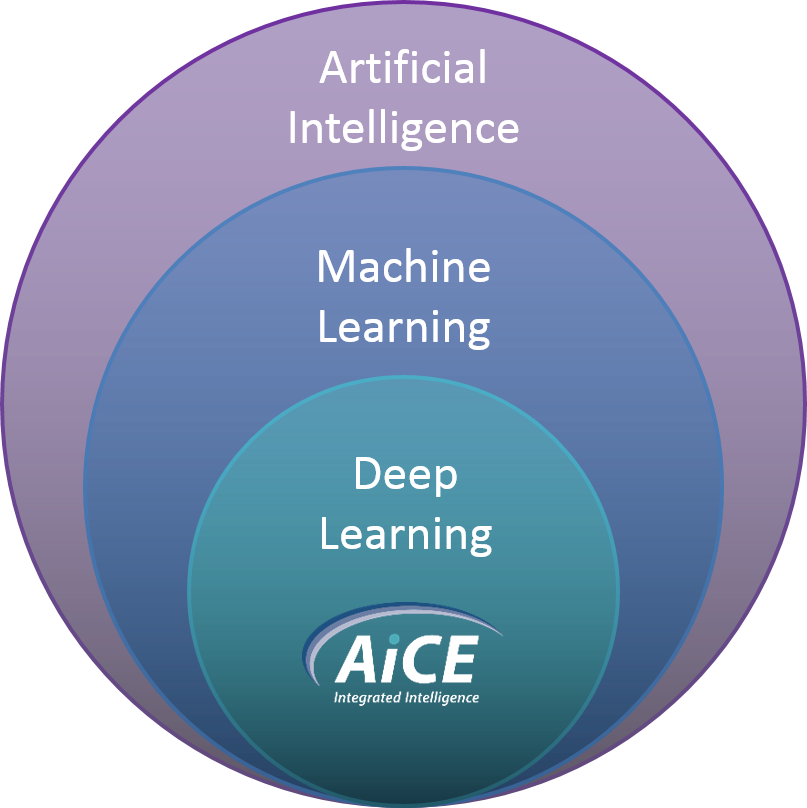
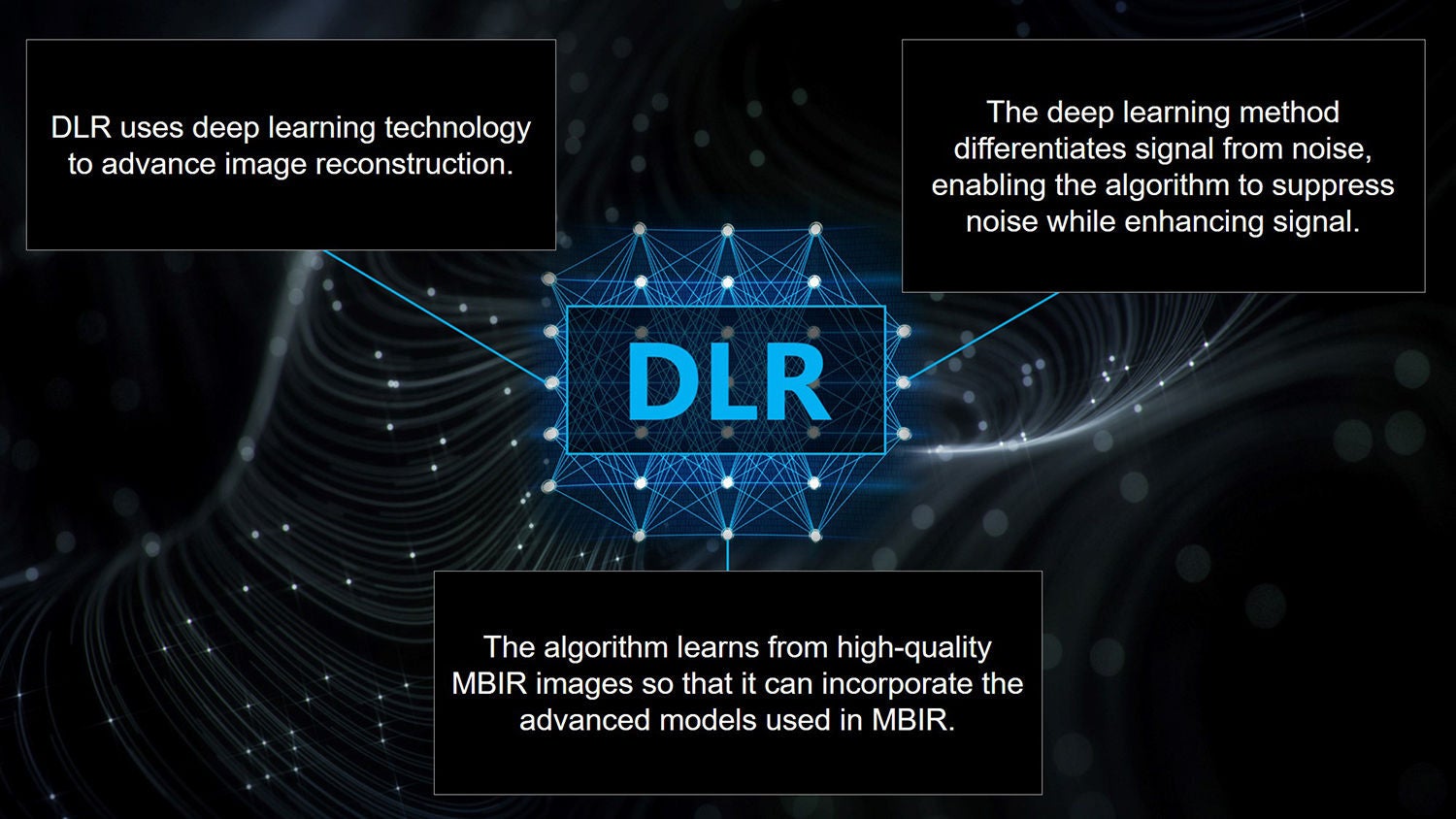
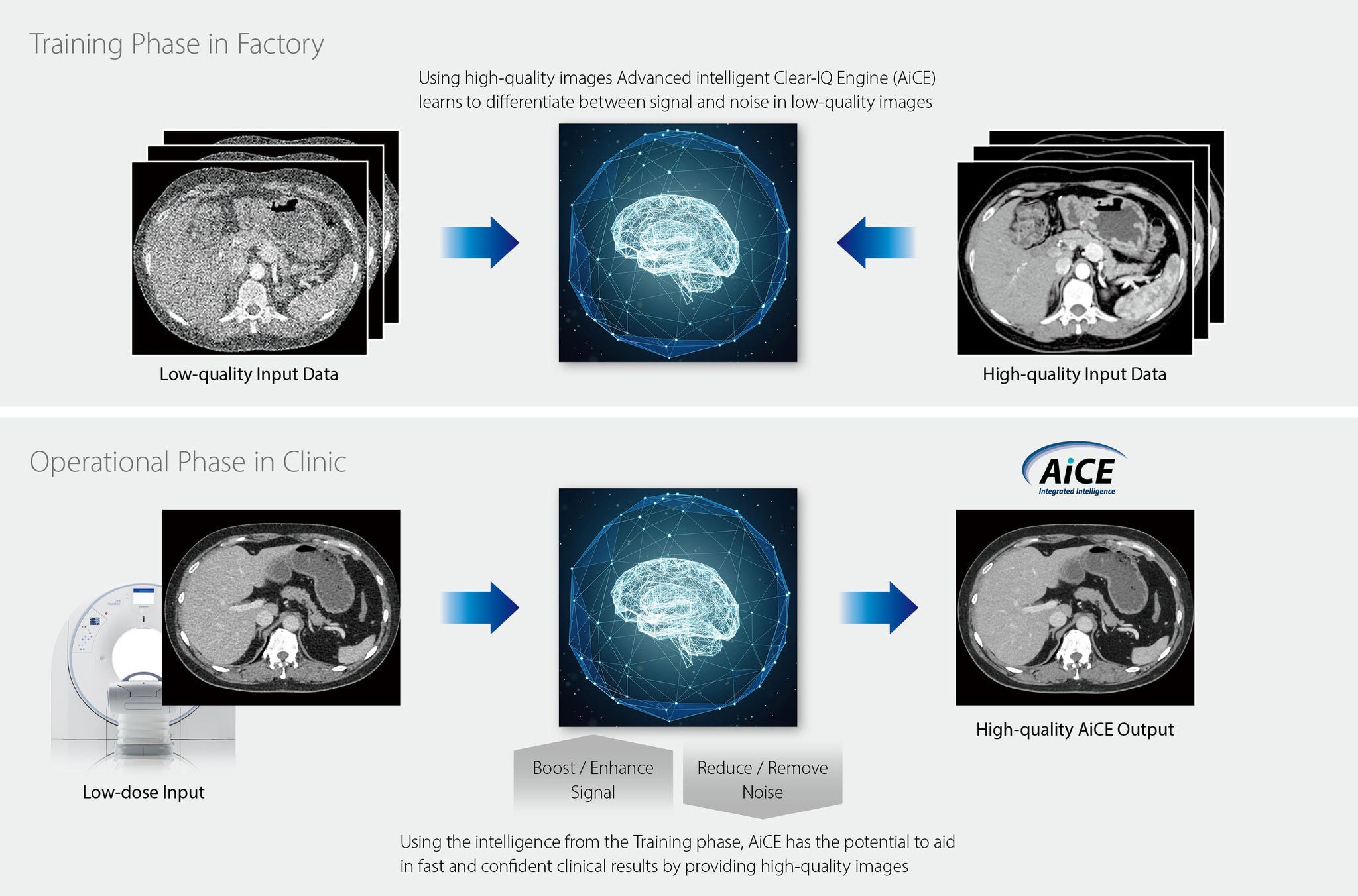
Tirant parti de l’énorme puissance de calcul d’un réseau neuronal convolutif profond, la technologie Advanced intelligent Clear-IQ Engine (AiCE) est « formée » pour distinguer le signal du bruit, de sorte que l’algorithme puisse supprimer le bruit tout en rehaussant le signal. Comme elle est formée grâce à la reconstruction itérative fondée sur des modèles (MBIR), elle fournit une résolution spatiale élevée. Or, contrairement à la MBIR, la technologie de reconstruction par l’apprentissage profond AiCE permet de surmonter les obstacles (apparence de l’image et[ou] vitesse de reconstruction) à l’adoption clinique.
Les avantages de la reconstruction par l’apprentissage profond AiCE :
・Notre meilleure résolution à faible contraste à ce jour. 1,2
・Une détectabilité des contrastes faibles, une réduction du bruit et une résolution spatiale améliorées par rapport à la reconstruction itérative hybride.
・Une texture du bruit d’image plus semblable à la RPF comparativement à la reconstruction MBIR.2
・Reconstruction rapide.
・Flux de travail plus aisé.
- 1.5mm @ 0.3%, 22 mGy
- Aquilion ONE / GENESIS Edition
Redéfinir l’équilibre entre QI, vitesse et dose
Reconstruction plus rapide :
・3 à 5 fois plus rapide que la MBIR1
Qualité d’image élevée :
・Résolution spatiale élevée en comparaison d’AIDR 3D
・Détectabilité améliorée des contrastes faibles en comparaison d’AIDR 3D
・Une apparence du bruit d’image plus semblable à la rétroprojection filtrée1
- Comparativement à la MBIR, s’applique seulement à AiCE sur les systèmes Aquilion ONE/GENESIS Edition
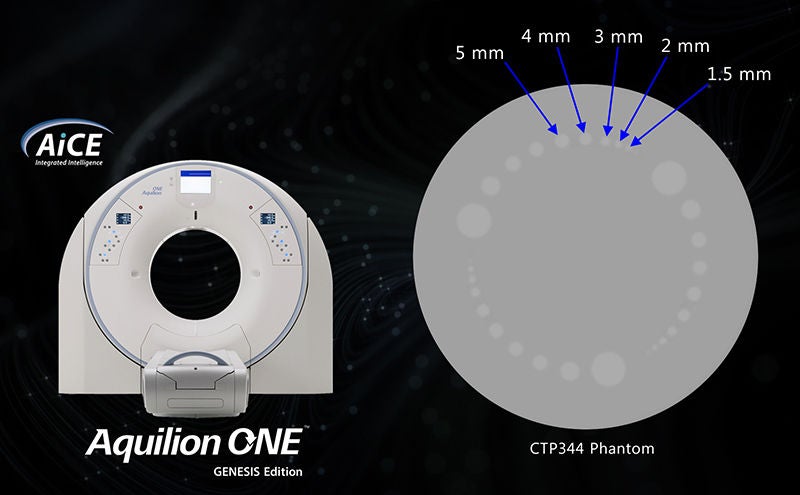
Détectabilité des contrastes faibles*
Corps, poumons et cœur
| Taille de l’objet | CTDIvol |
| 3 mm à 0,3% | 5,3 mGy |
| 2 mm à 0,3% | 10,5 mGy |
| 1.5mm à 0,3% | 22,6 mGy |
| Paramètres d’examen | |
| 10 mm avec AiCE en imagerie corporelle | |
| Fantôme | |
| CTP344, Phantom Labs | |
- Aquilion ONE / GENESIS Edition
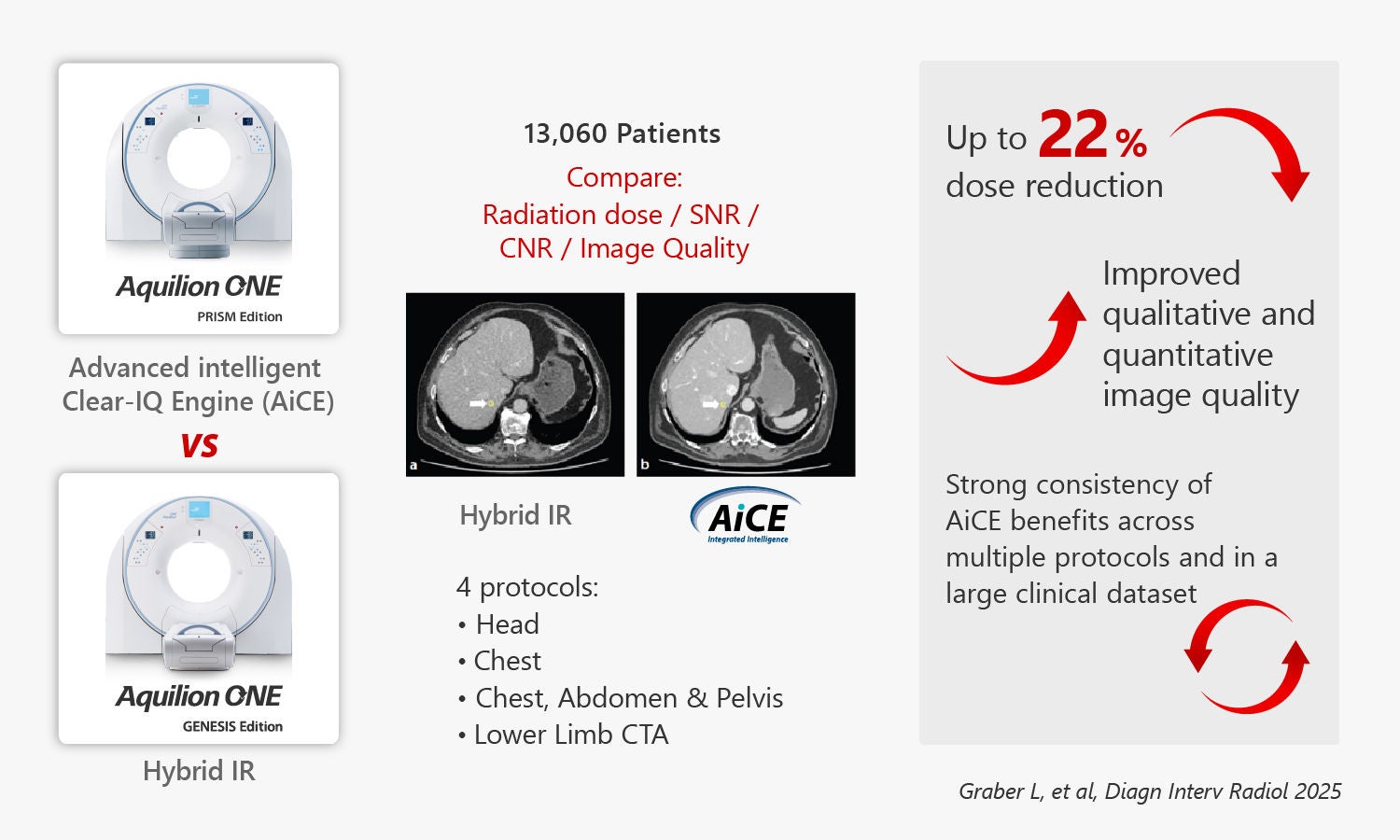
Latest research
Potential radiation dose reduction in computed tomography with deep learning reconstruction: a retrospective monocentric study

PUBLICATIONS SCIENTIFIQUES
Veuillez noter que les publications sont en anglais seulement.
Chuluunbaatar et. al | Deep learning reconstruction allows for usage of contrast agent of lower concentration for coronary CTA than filtered back projection and hybrid iterative reconstruction | Acta Radiol. (2023)
Goto et al. | Lung-Optimized Deep-Learning-Based Reconstruction for Ultralow-Dose CT |Acad Radiol. (2023)
Ludes et al. | Impact of a reduced iodine load with deep learning reconstruction on abdominal MDCT | Medicine (Baltimore). (2023)
https://pubmed.ncbi.nlm.nih.gov/37657067/
Zhang et al. | Image quality comparison of lower extremity CTA between CT routine reconstruction algorithms and deep learning reconstruction | BMC Med Imaging (2023)
https://pubmed.ncbi.nlm.nih.gov/36800947/
Chuluunbaatar et al. | Improvement in Image Quality and Visibility of Coronary Arteries, Stents, and Valve Structures on CT Angiography by Deep Learning Reconstruction | J Radiol. (2022)
https://pubmed.ncbi.nlm.nih.gov/36196766/
Greffer et al. | Effect of a new deep learning image reconstruction algorithm for abdominal computed tomography imaging on image quality and dose reduction compared with two iterative reconstruction algorithms: A phantom study | Quantitative Imaging in Medicine and Surgery (2022)
https://pubmed.ncbi.nlm.nih.gov/34993074/
Michallek et al. | Deep learning reconstruction improves radiomics feature stability and discriminative power in abdominal CT imaging: a phantom study | Eur Radiol. (2022)
https://pubmed.ncbi.nlm.nih.gov/35174400/
Mikayama et al. | Deep-learning reconstruction for ultra-low-dose lung CT: Volumetric measurement accuracy and reproducibility of artificial ground-glass nodules in a phantom study | Br J Radiol. (2022)
https://pubmed.ncbi.nlm.nih.gov/34908478/
Takafuji et al. | Deep-learning reconstruction to improve image quality of myocardial dynamic CT perfusion: comparison with hybrid iterative reconstruction | Clin Radiol. (2022)
https://pubmed.ncbi.nlm.nih.gov/35853777/
Tanabe et al. |Deep learning-based reconstruction of chest ultra-high-resolution computed tomography and quantitative evaluations of smaller airways | Respir Investig. (2022)
https://pubmed.ncbi.nlm.nih.gov/34824028/
Zhang et al. | Value of deep learning reconstruction at ultra-low-dose CT for evaluation of urolithiasis | European Radiology (2022)
https://pubmed.ncbi.nlm.nih.gov/35357541/
Bernard et al. | Deep learning reconstruction versus iterative reconstruction for cardiac CT angiography in a stroke imaging protocol: reduced radiation dose and improved image quality | Quant Imaging Med Surg. (2021)
https://pubmed.ncbi.nlm.nih.gov/33392038/
Chuluunbaatar et al. | Improvement of depiction of the intracranial arteries on brain CT angiography using deep learning reconstruction | J Integr Neurosci. (2021)
https://pubmed.ncbi.nlm.nih.gov/34997719/
McLeavy et al. | The future of CT: deep learning reconstruction | Clin Radiol. (2021)
https://pubmed.ncbi.nlm.nih.gov/33637310/
Tamura et al. | Superior objective and subjective image quality of deep learning reconstruction for low-dose abdominal CT imaging in comparison with model-based iterative reconstruction and filtered back projection | Br J Radiol. (2021)
https://pubmed.ncbi.nlm.nih.gov/34142867/
Lenfant et al. | Deep Learning Versus Iterative Reconstruction for CT Pulmonary Angiography in the Emergency Setting: Improved Image Quality and Reduced Radiation Dose | Diagnostics (2020)
https://pubmed.ncbi.nlm.nih.gov/32759874/
Nakamura et al. | Possibility of Deep Learning in Medical Imaging Focusing Improvement of Computed Tomography Image Quality | J Comput Assist Tomogr (2019)
https://pubmed.ncbi.nlm.nih.gov/31789682/
Higaki et al. | Improvement of image quality at CT and MRI using deep learning | Japanese Journal of Radiology (2019)
https://pubmed.ncbi.nlm.nih.gov/30498876/
Akagi et al. | Deep learning reconstruction improves image quality of abdominal ultra-high-resolution CT | European Radiology (2019)
https://eprintservices.trustrack.com/weblink/d7f5762d69bfb82e016c046e2fe87975
Social Media


